


auch als Buch erhältlich
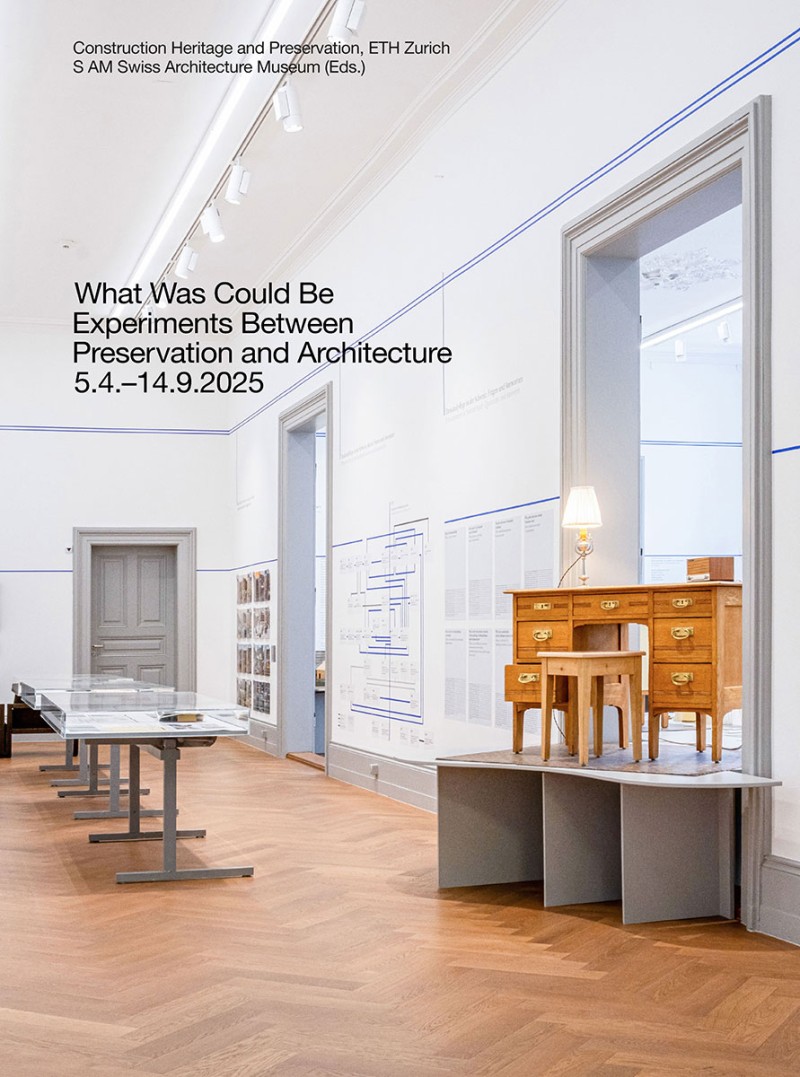
What Was Could Be: Experiments Between Preservation and Architecture / Was War Werden Könnte: Experimente zwischen Denkmalpflege und Architektur
- 5.4.–14.9.2025
Monument Protection, Preservation, Collaborations, City Theater Basel, Schatzalp Hotel, Kongresshaus Zurich
Denkmalpflege, Zusammenarbeit, Stadttheater Basel, Berghotel Schatzalp, Kongresshaus Zürich
Preservation is progressive: In current efforts to shift towards more sustainable building practices (known in German as the Bauwende, or ‘building turnaround’), preservation and maintenance of the existing building stock play a central role. The alteration or conversion of an existing building is considerably more resource-efficient than a comparable new build. This is leading to changes in the nature of architecture itself: Where the focus used to be on new construction, building upon the built is increasingly considered the future of the discipline.
In this context, the theory and practice of historic preservation also gain a new urgency. The discipline has always regarded the built stock as a valuable resource and has developed different methods and approaches to carefully preserve the existing for the future. What can be learned from this approach and what new impulses can arise from a deeper dialogue between preservation and architecture?
The exhibition takes the 50th anniversary of the European Architectural Heritage Year of 1975 as an opportunity to look at the past, present, and future of preservation and explore new possibilities for its cooperation with architecture.
Creative Commons License CC BY 4.0: https://creativecommons.org/licenses/by/4.0/
Bewahren ist fortschrittlich: In der aktuellen Debatte um die Bauwende spielen Erhalt und Pflege des Gebäudebestandes eine zentrale Rolle. Der Umbau oder die Umnutzung eines bereits existierenden Gebäudes ist gegenüber einem vergleichbaren Neubau wesentlich ressourcenschonender. Entsprechend verändert sich das Wesen der Architektur – wo früher der Fokus auf dem Neubau lag, gilt nun das Bauen im Bestand als die Zukunft der Disziplin.
Vor diesem Hintergrund bekommen die Theorie und Praxis der Denkmalpflege eine neue Dringlichkeit. Seit jeher versteht diese Disziplin den gebauten Bestand als eine wertvolle Ressource und hat verschiedene Methoden und Ansätze entwickelt, das Vorhandene sorgsam in die Zukunft zu überführen. Was lässt sich von dieser Herangehensweise lernen, und welche neuen Impulse können aus einem vertieften Dialog zwischen Denkmalpflege und Architektur entstehen?
Die Ausstellung nimmt das 50. Jubiläum des Europäischen Denkmalschutzjahrs 1975 als Anlass, um auf Vergangenheit, Gegenwart und Zukunft der Denkmalpflege zu blicken und neue Möglichkeiten für die Kooperation mit der Architektur auszuloten.
Creative-Commons-Lizenz CC BY 4.0: https://creativecommons.org/licenses/by/4.0/
We support open access (free download), what about you?
- Auflage: 1., 2025
- Seiten: 72 Seiten
- Abbildungen: zahlreiche Fotos, farbig
- Format in cm: 14,8 x 21,0
- Einbandart: PDF
- ISBN: 978-3-7281-4219-1
- DOI: 10.3218/4219-1
- Sprache: Englisch / Deutsch
- Lieferstatus: lieferbar